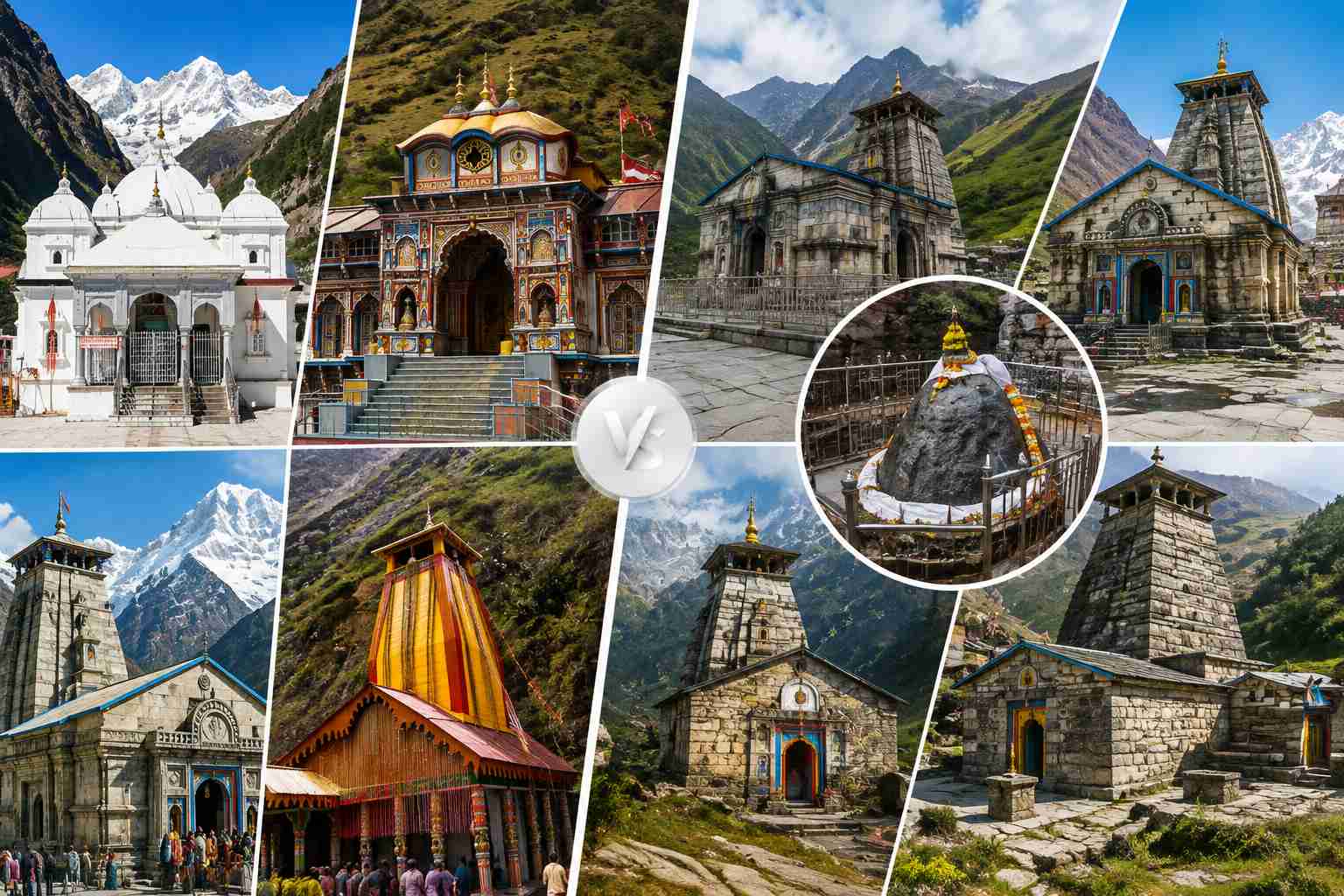
Uttarakhand is often called Devbhoomi, or “Land of Gods,” and is home to many of India’s most sacred Himalayan pilgrimage sites. Among them, the Char Dham Yatra and Panch Kedar have special importance. Both feature sacred temples, dramatic mountain landscapes and deep-rooted Hindu traditions, but they offer very different pilgrimage experiences.
If you are wondering whether Chardham tour packages or Panch Kedar Yatra is best suited to your spiritual travel plans, knowing their differences can help you choose the right circuit.
What Is Char Dham Yatra?
The Uttarakhand Char Dham consists of four main shrines which are Yamunotri, Gangotri, Kedarnath and Badrinath. Traditionally, the pilgrimage is performed in a west-to-east and clockwise sequence starting from Yamunotri, followed by Gangotri, Kedarnath and Badrinath.
Each shrine has a spiritual meaning:
- Yamunotri: Dedicated to Goddess Yamuna and usually the start of the circuit.
- Gangotri: Dedicated to Goddess Ganga and connected to the descent of the sacred river to Earth.
- Kedarnath: One of the most revered shrines of Lord Shiva, and one of the 12 Jyotirlingas.
- Badrinath: A temple to Lord Vishnu, located on the bank of the Alaknanda River.
Since Char Dham involves four major temples, long journeys by road and trekking at high altitudes, it is generally planned as a complete pilgrimage rather than a short visit to the temples.
Panch Kedar Yatra:
Panch Kedar is a cluster of five ancient Shiva temples located in the Garhwal Himalayas - Kedarnath, Tungnath, Rudranath, Madhya Maheshwar and Kalpeshwar. The temples are associated according to popular tradition with the Pandavas and the manifestation of Lord Shiva in different forms.
The five shrines are:
- Kedarnath – linked with hump of lord shiva.
- Tungnath – connected to his arms and considered one of the highest Shiva temples.
- Rudranath – related to his face.
- Madhya Maheshwar – related to his middle or navel region.
- Kalpeshwar – related to his matted hair.
Unlike Char Dham, Panch Kedar is more of a Shiva pilgrimage. It also has a more pronounced trekking character, with several shrines demanding quite a bit of walking through forests, meadows and mountain trails.
Char Dham vs Panch Kedar: Differences
Kedarnath is part of both the circuits, but the overall experiences are quite different.
| Factor |
Char Dham |
Panch Kedar |
| Main focus |
Four important pilgrimage sites in the Himalayas |
Five Shiva temples |
| Principal deities |
Yamuna, Ganga, Shiva and Vishnu |
Lord Shiva |
| Trekking |
Required at some shrines |
More extensive overall |
| Travel style |
Road-based pilgrimage with trekking sections |
Trekking-focused spiritual journey |
| Suitable for |
Families, senior pilgrims and first-time visitors with proper planning |
Experienced trekkers and dedicated Shiva devotees |
| Duration |
Typically, multi-day circuit |
Often requires additional time due to remote trails |
For travellers booking Chardham yatra tour packages, it is generally easier to structure the journey around established road routes, accommodation stops and pilgrimage facilities.
Panch Kedar however requires more attention to trekking distances, weather conditions, fitness and local logistics.
What’s the Hardest Pilgrimage?
It depends on what you mean by “difficult.”
Char Dham means long road journeys, varying mountainous conditions, high altitudes and the famous trek to Kedarnath. From Janki Chatti too, Yamunotri has a steep walking section. As of now, Uttarakhand Tourism describes the Yamunotri approach as a trek of about 3 km.
Kedarnath would involve a much longer uphill trek from the roadhead.
The trekking in Panch Kedar is difficult. Tungnath, Rudranath and Madhyamaheshwar involve mountain trails and several temples are in remote locations, so travellers need to plan accommodation, transport and walking schedules carefully. Kalpeshwar is relatively easy to reach and is the only Panch Kedar temple, which is open all year round, Uttarakhand Tourism said.
What To Pick?
Select Char Dham If You:
- Wish to perform the four major Himalayan pilgrimage shrines of Uttarakhand.
- Are travelling with family or a mixed age group.
- Like a mix of road travel, temple visits and easy trekking.
- Wants a well-organised pilgrimage program with travel arrangements ready to go.
- Interested in Chardham tours from Ahmedabad and looking for a full spiritual holiday.
Select Panch Kedar If You:
- Be very devoted to Lord Shiva.
- Enjoy trekking and the remote Himalayan landscapes.
- Want more immersive and quieter pilgrimage experience.
- Are at ease on physically demanding mountain trails.
- Allow ample time for a slower, trekking-oriented itinerary.
Is It Possible to Combine Char Dham and Panch Kedar?
Yes, but it takes some planning. As Kedarnath is common to both circuits, a well-designed itinerary can include other Panch Kedar temples around a Char Dham journey. Rushing to do both circuits though can make the trip unnecessarily exhausting.
For travellers looking for more convenience, Chardham yatra by helicopter can reduce road travel time and save time, but helicopter operations are still dependent on weather, operational conditions and applicable regulations. A helicopter-assisted itinerary will not remove the need to be prepared for altitude and walking requirements at the shrines.
When to Go on Pilgrimage
The snow fall in winter makes the access difficult, so most of the high-altitude Char Dham shrines are seasonal. According to Uttarakhand Tourism, the main shrines generally open in spring or early summer and close around October or November.
For Panch Kedar, the opening and closing schedules are different for each temple. Therefore, before departure, travellers should check the current temple opening dates, registration requirements, weather advisories and route conditions instead of relying on an old itinerary.
Char Dham or Panch Kedar: The Final Choice?
There is no one “better” pilgrimage. Chardham tours are ideal for travellers who want a wider spiritual experience, covering four iconic shrines in the Himalayas. Panch Kedar is for those who want a more profound Shiva pilgrimage with trekking and solitude.
Whatever route you take, treat the Himalayas with respect. Allow time for acclimatisation, avoid over-scheduled plans and follow official travel advisories. With a bit of careful planning, both circuits can be turned into more than just temple visits, they can become deeply personal journeys through Uttarakhand’s sacred mountains.